
3 hr
Topkapi Palace & Harem Guided Tour: Skip-the-Line Entry
- Expert local guide
- Small group
- Skip-the-line access
- Free cancellation
Topkapi Palace Private Guide — Reserved Entry Through Four Courtyards
Marble gates open at dawn, the Bosphorus waits below.
Compare fares, pick the fit — all bookings are mobile-voucher and eligible for free cancellation where shown.
3 hr
7 hr
3 hr
Choosing tickets for a topkapi palace private guide visit comes down to three real options: the palace-only entry, the Palace-with-Harem combined ticket, and the Museum Pass Istanbul. Each suits a different kind of Istanbul landmarks itinerary, so matching the pass to your priorities matters more than grabbing the first option online.
| Palace-Only Ticket (Main Courtyards) |
Top pick Palace with Harem (Combined Ticket) |
Museum Pass Istanbul (Multi-Site Pass) | |
|---|---|---|---|
| What's included | Palace complex, courtyards, core exhibits, Hagia Irene | Palace, Hagia Irene, plus Harem quarters | Topkapi Palace entry bundled with other Istanbul museums |
| Harem access | — | — | |
| Price | Lower than combo, exact rate varies | 3,000 TRY per adult foreign visitor | 5-day pass around 105 € foreign visitors |
| Best for | Budget visitors skipping the Harem | First-timers wanting the full palace story | Multi-museum sightseers on a longer trip |
| Line-skipping | Available with online purchase | Available with online purchase | Priority entry windows at participating sites |
| Flexibility | Valid one day, flexible entry time | Valid one day, flexible entry time | Valid across its multi-day window, reusable at other sites |
| See tickets & prices |
Verdict: First-time visitors booking a topkapi palace private guide tour should choose the Palace-with-Harem combo, while multi-attraction travelers on a skip-the-line topkapi palace private guide tickets budget may prefer the Museum Pass instead.
Worth it for first-timers, skippable for repeat visitors
A good topkapi palace private guide runs well above the 3,000 TRY Palace-with-Harem entry, so the real question is what the added cost buys. What you pay covers a lot of ground: the Treasury's imperial jewels, the Sacred Relics chambers, the Harem, the tiled Imperial Council hall, the palace kitchens, and the Bosphorus-facing terraces. Against other Istanbul landmarks, where entry rarely clears a fraction of this, the fee sits high but the density of what's inside justifies it. Where topkapi palace private guide tours earn their keep is context: the Ottoman court's protocol, the meaning behind the relics, the layered politics of the Harem — none of it is signposted well. For a single unhurried visit, the guided route pays off. Repeat visitors, budget travelers, or anyone comfortable reading ahead can walk the same halls solo and pocket the guide fee.
Bottom line: For a first, unhurried visit to this Sultanahmet landmark, topkapi palace private guide tickets pay for themselves in context; everyone else can safely go solo.
Hand-picked experiences loved by thousands of travelers
7 hours
Free Cancellation
Explore Istanbul’s iconic Byzantine and Ottoman landmarks with a dedicated guide on a fully private, customizable day tour.
7 hours to 3 days
Free Cancellation
Experience Istanbul your way with a fully customizable, private guided adventure tailored to your personal interests.
2 - 4 hours
Free Cancellation
Trace the majesty of the Ottoman Empire through Istanbul’s historic heart with a private, expert-led walking tour.
Enter through Bab-ı Hümayun and walk past Hagia Irene toward the ticket gate
View the Imperial Council Chamber and Palace Kitchens with Chinese porcelain
Tour the sultan's private quarters and the Courtyard of the Concubines
See the Spoonmaker's Diamond and Topkapi Dagger in the Treasury
View Islamic relics under continuous Quran recitation, no photography
Finish at the Bosphorus-view terrace pavilions and gardens
This domed chamber in the Second Courtyard housed the Ottoman Empire's governing council, where grand viziers met while the sultan reportedly observed proceedings unseen through a grilled window above. Its blue-and-gold Baroque decoration dates largely from 18th-century restorations.
Housed in the Third Courtyard, the Treasury displays the 86-carat Spoonmaker's Diamond and the emerald-hilted Topkapi Dagger, both among the most photographed objects in Istanbul. The collection spans centuries of Ottoman imperial gem-work and ceremonial weapons.
A maze of over 400 rooms once housed the sultan's family, wives, and concubines under strict hierarchy, though only a portion is open to visitors today. The Courtyard of the Concubines and the Golden Road corridor remain among its best-preserved sections.
This chamber holds Islamic relics including items attributed to the Prophet Muhammad, displayed under continuous Quran recitation performed in rotating shifts since Ottoman times. Photography is strictly prohibited throughout the room.
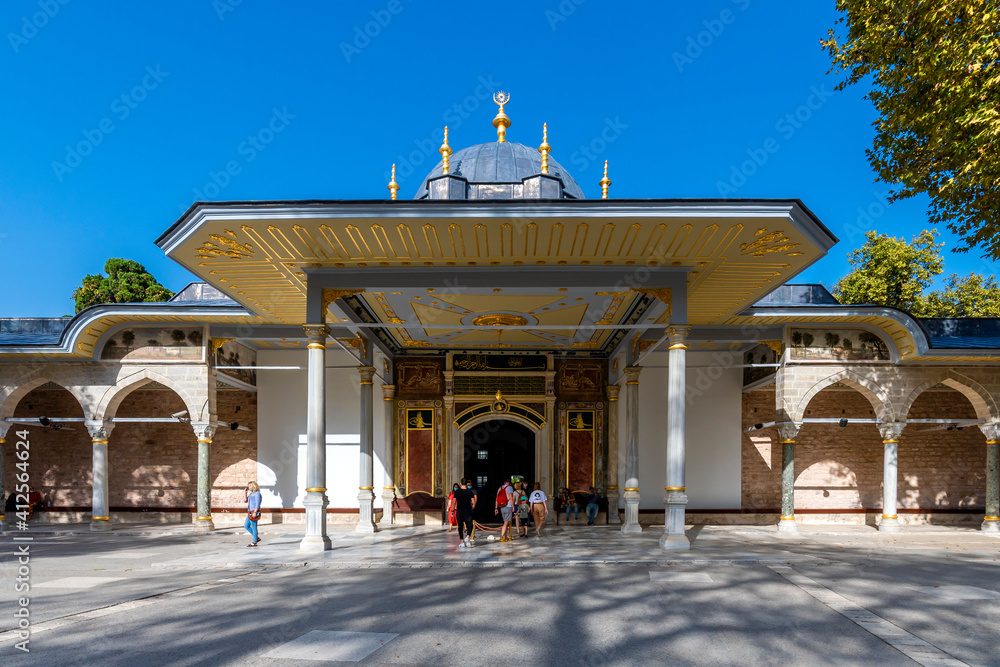
This ceremonial gate marks the entrance to the Third Courtyard and once served as the backdrop for imperial enthronement ceremonies. Its canopied Ottoman Rococo styling contrasts with the plainer gates preceding it.
The palace's uppermost courtyard holds the Baghdad and Revan Pavilions along with tiered gardens overlooking the Golden Horn and Bosphorus. Sultans reportedly used this terrace for private relaxation away from court affairs.
You arrive at the Imperial Gate in the 09:00–10:30 window, before the coach groups reach the Treasury, and your guide meets you beneath the marble arch. You cross the first courtyard on foot, past the church of Hagia Irene, and stop at the Gate of Salutation where a topkapi palace private guide tour begins in earnest. You move into the second courtyard and pause at the palace kitchens, ten domed chimneys rising in a row, then follow the path toward the Divan, where imperial councils once met beneath a gilded grille. You climb toward the Harem, ducking through low doorways into tiled chambers, and you slow down here, because the Iznik panels reward a close look. You reach the Treasury next, timing your entry so the Spoonmaker's Diamond and the Topkapi Dagger sit behind glass you can actually approach rather than queue behind. You step out onto the fourth-courtyard terrace, where the Baghdad Kiosk opens onto a view of the Golden Horn, and you catch your breath above the water. You finish at the Chamber of Sacred Relics, quiet after the crowds, then walk back through the gates you entered, the sequence now legible in reverse.
All the details about your upcoming adventure in one place
Walk the courtyards of the Ottoman sultans alongside a licensed topkapi palace private guide who brings the Imperial Council chamber, the Gate of Felicity, and the palace treasury to life with clear historical context. Our Istanbul Topkapi Palace tours pair small-group attention with skip-the-line access, so you spend your time exploring the Harem and Bosphorus terrace views rather than waiting in queues. Booking topkapi palace private guide tours also opens the door to the wider UNESCO heritage of the old city, from the Sea of Marmara panoramas to the peninsula's Byzantine landmarks.
Mehmed II ordered construction of Topkapi Palace in 1459, six years after his conquest of Constantinople, and for nearly four centuries it served as the administrative heart of an empire that stretched across three continents. A topkapi palace private guide draws its material from a residence that once housed some four thousand people behind its walls, a self-contained city on the promontory where the Bosphorus meets the Golden Horn and the Sea of Marmara. The palace is organised not as a single building but as a sequence of four courtyards, each more restricted than the last. Visitors pass through the Imperial Gate, then the Gate of Salutation, moving inward toward spaces once reserved for the sultan and his closest household. The Harem alone contains more than three hundred rooms arranged around narrow passages and tiled chambers, its walls faced in Iznik ceramics whose cobalt and coral patterns have not faded in five hundred years. An istanbul topkapi palace tour reveals how proximity to power was measured in physical distance, courtyard by courtyard. The collections carry weight beyond their setting. The Imperial Treasury holds the Topkapi Dagger and the Spoonmaker's Diamond, an eighty-six-carat stone set in a double row of brilliants. The Chamber of Sacred Relics safeguards objects of profound religious significance, including items attributed to the Prophet Muhammad, before which a reciter has read the Quran continuously since the sixteenth century. These rooms reward the context a topkapi palace private guide provides, because the significance of what sits in each vitrine is rarely self-evident to the eye. Why the palace matters today extends past its inventory. When the sultanate moved to the Dolmabahce Palace in 1856, Topkapi began its long transition, and in 1924 the young Turkish Republic converted it into a museum, one of the first acts of the new state's cultural policy. It joined the UNESCO World Heritage List in 1985 as part of the Historic Areas of Istanbul. Architecturally, Topkapi resists the symmetry of European palaces built in the same centuries. It grew by accretion, each sultan adding pavilions, kitchens and kiosks according to need rather than a master plan, so that the Baghdad Kiosk and the Circumcision Room sit within sightlines of terraces overlooking the water. The result is a landscape of Ottoman craftsmanship, where guided walks through Sultanahmet landmarks connect gate to garden to gilded canopy, and where the sheer density of detail explains why a single unguided visit so often leaves the deeper story untold.
Proximity to power was measured in physical distance, courtyard by courtyard.
Modest clothing is recommended throughout Topkapi Palace, covering shoulders and knees, though there is no strict enforcement outside the Sacred Relics section. Comfortable, closed-toe shoes matter more than formal dress, since courtyards are paved with uneven historic stone. Visitors on a topkapi palace private guide tour should avoid high heels given the amount of walking between the four courtyards.
Airport-style security screening with metal detectors and bag X-ray sits at the main Imperial Gate entrance. Large backpacks, suitcases, and bulky bags may be asked to pass through additional checks or be left at the entrance, so a small daypack is the practical choice for a topkapi palace private guide visit. Lines at security build quickly once tour buses arrive after mid-morning.
Photography and filming are permitted in the courtyards, Treasury displays, and most exhibition rooms, but strictly prohibited inside the Sacred Relics (Holy Relics) Room. Flash photography and tripods are not allowed anywhere inside the palace interiors. Museum staff actively enforce the no-photo rule in the relics section.
Children generally handle the outdoor courtyards well, but the Sacred Relics Room and Treasury queues can be tiring for younger kids given the crowds. Strollers are difficult to manage on the stone paving, so a carrier is more practical for toddlers.
Topkapi Palace's courtyards are large open spaces with ramps in some areas, but many original chambers have raised thresholds, cobblestone paths, and steps that limit full wheelchair access. Visitors with mobility needs should plan extra time between the First and Fourth Courtyards, as distances are considerable and mostly outdoors.
A café with courtyard seating and Bosphorus views operates near the Fourth Courtyard terrace, serving Turkish tea, coffee, and light meals. Outside food is not permitted inside the exhibition halls, though bottled water is allowed given the summer heat. Picnicking is not permitted within the palace grounds.
Palace opens, moderate morning crowds
Weekly closure day
Quieter than weekend
Busy with tour groups midday
Blue Mosque closed, palace busier
Peak weekend crowds
Hours
Wed–Mon 09:00–17:00, closed Tuesday
Address
Cankurtaran Mah., Sultanahmet, Fatih, 34122 Istanbul, Turkey
Access
Uneven courtyards, limited step-free routes in older sections
Best Arrival
09:00–10:30 to beat tour groups before Treasury and Sacred Relics rooms fill
Bag Policy
Small bags allowed, large luggage and backpacks restricted at security
Layout
Four courtyards from outer gate to inner palace chambers
Public transport · 10–15 min from tram stop · Tram fare via Istanbulkart
Take the T1 tram line to Sultanahmet stop, then walk roughly 10 minutes past Hagia Sophia to the palace entrance
Walk · 5–10 min · Free
From Sultanahmet Square, the palace is a flat, short walk past Hagia Sophia and through Gülhane Park
Taxi · 20–30 min from Taksim · Metered fare, moderate cost
Taxis from Taksim or Beyoğlu reach Sultanahmet in normal traffic, dropping off near the Imperial Gate
Tickets booked for a topkapi palace private guide visit are typically non-refundable once the date has passed, but most private guide operators allow free rescheduling up to 24 hours before the visit. The entrance fee of 3,000 TRY per adult foreign visitor for the Palace with Harem is generally not refunded for no-shows.
Recommended time
3-4 hours
That window covers the courtyards, Treasury, and Sacred Relics Room at an unhurried pace; add roughly 45-60 minutes if you're bringing a Harem-only add-on, since its narrow corridors take longer to move through once crowds build. Arrive right at the 09:00-10:30 opening window and the queue reality is simple: you'll walk into the Harem and Treasury nearly empty, then watch coach groups fill both by mid-morning. A topkapi palace private guide can compress this further by routing you around the surge instead of into it, though independent visitors following the same order do just as well.
Crowd levels through the day
Weather · crowds · average price — dots go green to amber to red as each metric rises.
March through May brings mild temperatures around 15–20°C and thinner crowds than summer, making it a comfortable season for a topkapi palace private guide tour.
June through August sees peak tourist volume and heat often above 30°C, so early mornings are notably more comfortable than midday.
September through November offers cooler weather and fewer cruise-ship crowds, similar to spring conditions.
December through February is the quietest season with occasional rain, and shorter daylight hours mean earlier visits are practical.
Arriving between 09:00 and 10:30 lets visitors reach the Treasury and Sacred Relics rooms before large tour groups fill the corridors.
Purchasing the Palace with Harem ticket covers the most historically significant sections in one transaction rather than paying separately later.
The courtyards use centuries-old stone paving that can be slick, especially near the Harem passageways.
Audio guide devices work best with wired headphones brought from outside since wireless pairing is inconsistent.
Guards enforce a strict no-flash and no-photo rule in the Sacred Relics Room, so keep phones away entirely in that hall.
Distances between the First and Fourth Courtyards are longer than they appear on the map, so budget walking time between sections.
The palace closes on the first day of religious holidays, which shift dates yearly on the lunar calendar.
Cankurtaran Mah., Sultanahmet, Fatih, 34122 Istanbul, Turkey
Main entrance facing Hagia Sophia, common meeting spot for guided groups
Get directionsOutside the Imperial Gate, Sultanahmet Square
Ottoman fountain landmark used as a group gathering point
Get directionsIn 1459, six years after taking Constantinople, Mehmed II ordered a new palace on Seraglio Point, the promontory where the Byzantine acropolis once stood. Work reached completion around 1478. The Sultan named it the New Palace to distinguish it from his earlier residence near the Grand Bazaar. Its later name, Topkapi, meaning Cannon Gate, came from a seaside gate long since gone. From here rulers governed the empire for nearly four centuries, and any thoughtful topkapi palace private guide begins its account with this founding decision. The layout grew as a sequence of four courtyards, each more restricted than the last. The outer gate, the Imperial Gate, opened to the public; the innermost court held the Sultan's private quarters. The Divan, where the imperial council met, dates to Mehmed's reign but was rebuilt under Suleiman the Magnificent in the 16th century. The Tower of Justice rose above it. Successive sultans added kitchens, libraries, and pavilions rather than replacing old work, so the complex reads as accumulated layers. The Harem, at first modest, expanded sharply after Suleiman moved his household here from the Old Palace around 1540. Under the influence of Hurrem Sultan and later valide sultans, it became a self-contained world of some four hundred rooms, its own mosques and baths, and its own hierarchy of eunuchs. This period of rising female power is sometimes called the Sultanate of Women. A quality topkapi palace private guide tour lingers here, because the Harem's tiled corridors record the quiet politics of succession. Fire damaged sections in 1574 and again in 1665, prompting extensive Baroque-influenced repairs. The long residential era ended in 1856, when Sultan Abdulmecid I moved the court to the new European-style Dolmabahce Palace on the Bosphorus. Topkapi kept the Sacred Relics and the treasury, but its rooms emptied of daily life. After the Ottoman sultanate was abolished, the palace was converted into a museum by decree in 1924, one of the earliest acts of the young republic. Today visitors move through the same four courts the pages once crossed. Guests booking topkapi palace private guide tickets can trace Mehmed's original walls, Suleiman's council chamber, and the Baroque flourishes of the eighteenth century in a single walk, while istanbul heritage tours frame Topkapi against the wider Sultanahmet skyline.
Mehmed II ordered a new palace built on Seraglio Point above the Bosphorus.
Construction of the New Palace, later called Topkapi, reached completion.
Suleiman the Magnificent rebuilt the Divan and moved his household into the Harem around 1540.
A major fire damaged the Harem and inner courts, prompting extensive rebuilding.
Abdulmecid I moved the court to Dolmabahce Palace, ending residential use.
The palace was converted into a museum by republican decree.
Topkapi remains open through its four courtyards, closed only on Tuesdays.
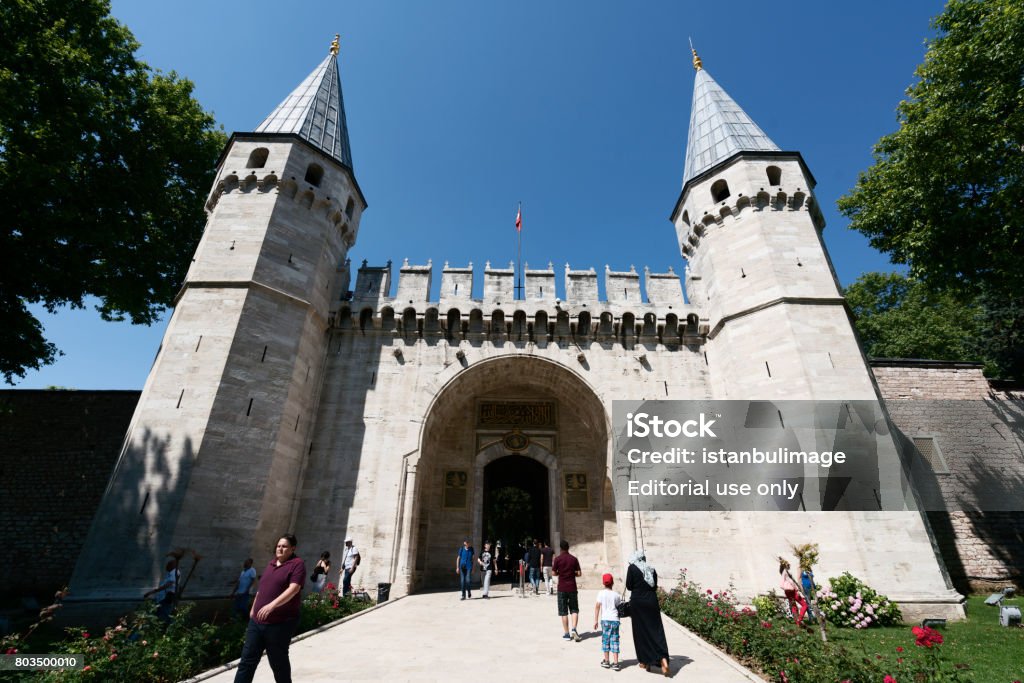
The twin conical-roofed towers of this fortress-like gate make a strong symmetrical frame shot from the First Courtyard cobblestones looking toward the Second Courtyard entrance. Stand back several meters to fit both towers in frame; this outdoor spot has no photography restrictions.
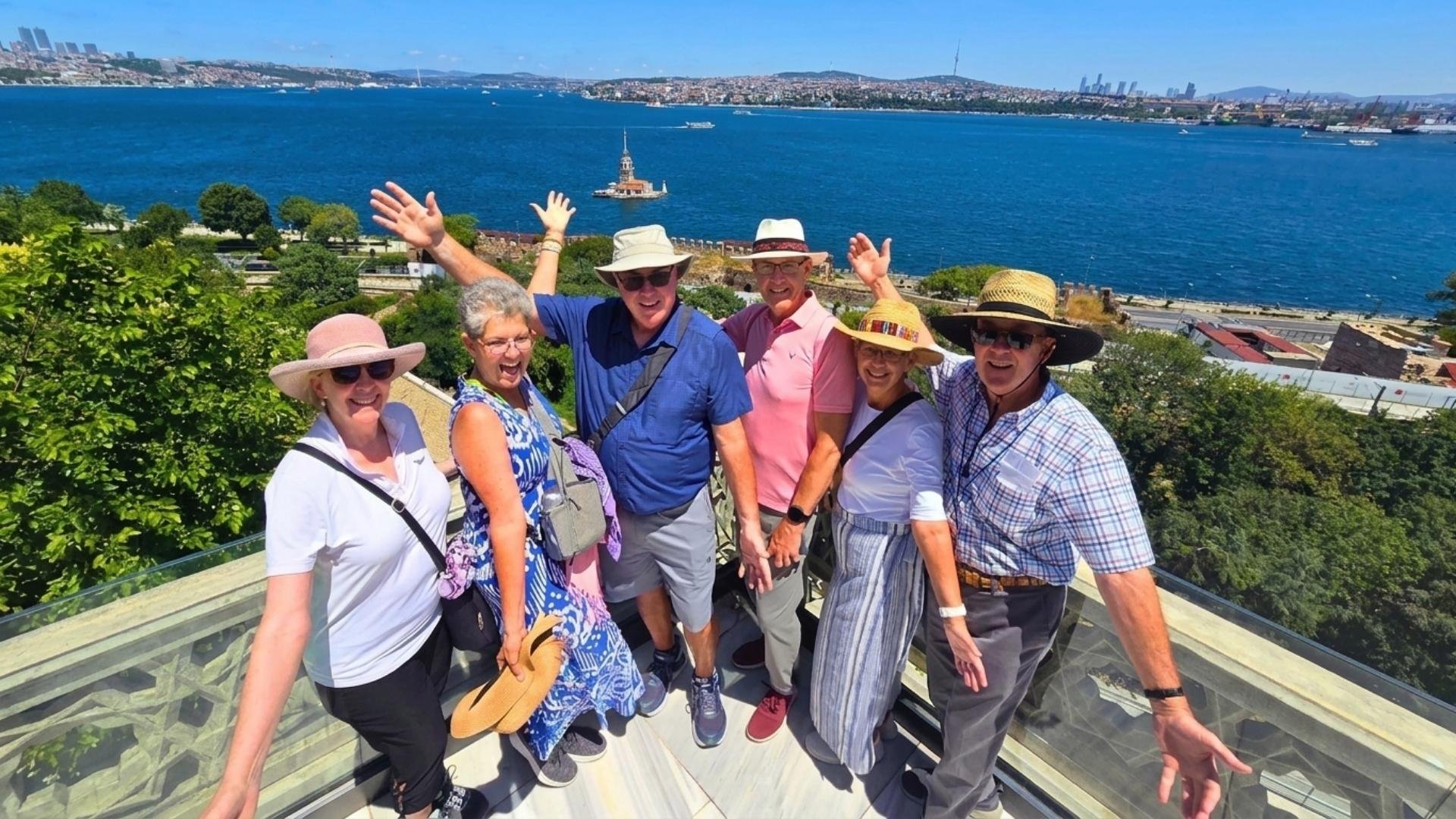
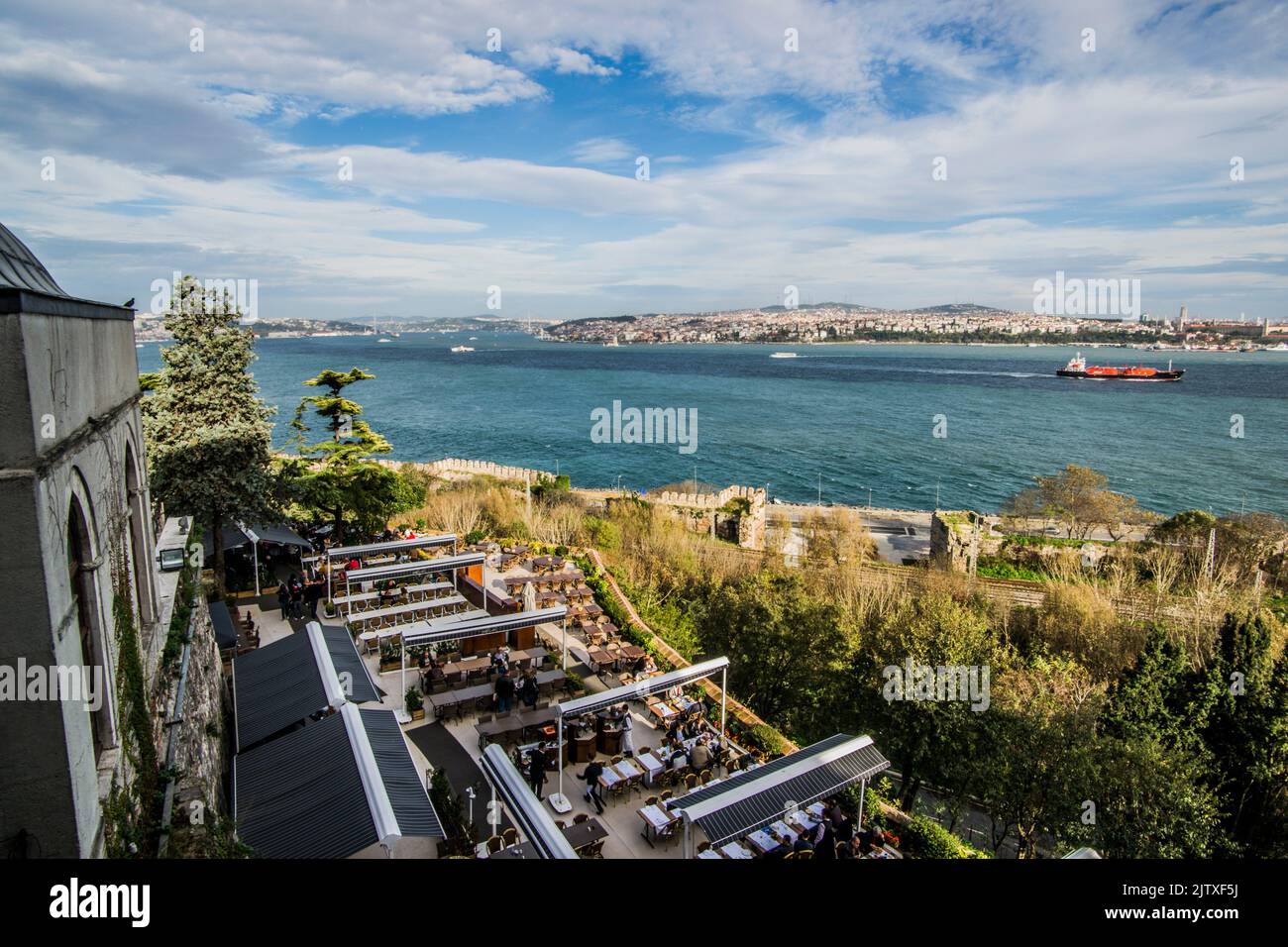
Travelers researching a topkapi palace private guide often single out this open terrace for its layered view over the Bosphorus, the Golden Horn, and the Asian shore in one frame. Shoot from the marble balustrade near the İftariye Kiosk for the widest panorama; the terrace is outdoors and unrestricted for photos.
This small gilded, open-sided pavilion perched on the Marble Terrace frames the Golden Horn and Galata Tower through its arched opening, a classic composition locals call the sultan's iftar balcony. Shoot from just outside or beneath the canopy; no flash or tripod needed since it's fully outdoors.
Built to mark the 1638 capture of Baghdad, its tiled portico and domed silhouette against the Fourth Courtyard garden make a strong architectural shot from the paved walkway facing the entrance steps. Interior shots are handheld only, no flash or tripod.
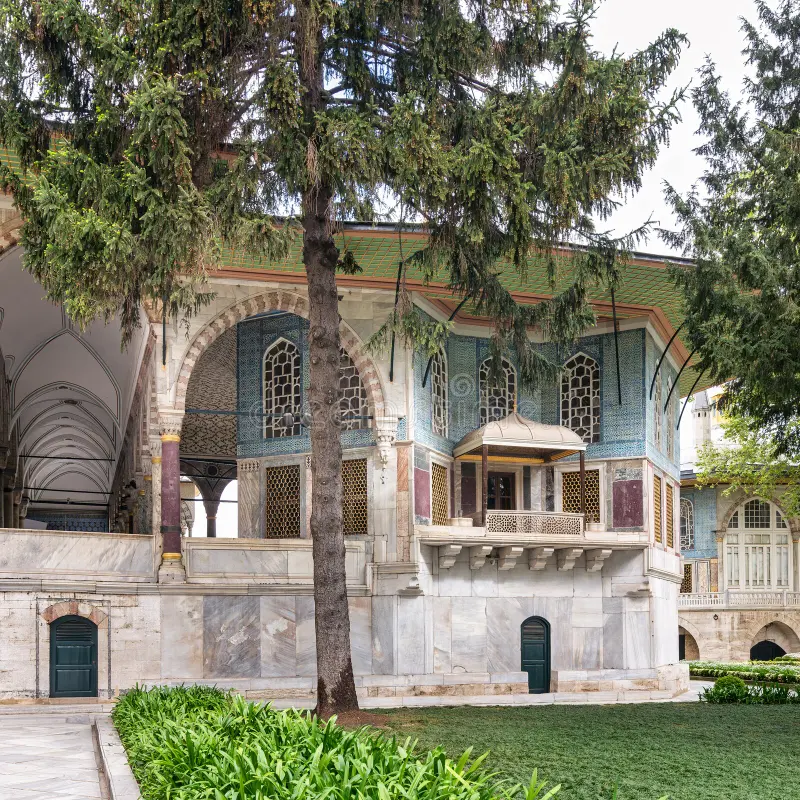
The exterior wall of the Sünnet Odası is covorded in dense blue-and-turquoise Iznik tile panels, best captured straight-on from the terrace path a few steps back to fit the whole facade. Photography is allowed here without flash or tripod, unlike the nearby Sacred Relics rooms where cameras are banned entirely.
A topkapi palace private guide visit with children means long stretches of open courtyards broken up by one genuinely tight, crowded pinch point: the Harem. Kids handle the palace grounds well but tire fast once the route narrows into corridors, so pacing matters more than distance covered.
Children eight and up get the most out of this site, since the Harem's narrow halls and dense history ask for patience that toddlers rarely have. Younger kids still enjoy the courtyards, cannons, and kiosks, just budget less time indoors.
The Harem is a maze of tiled hallways and small rooms with no open-air relief until you exit, so it's the single hardest stretch for a fidgety child. Go early in your visit before the queues and crowds inside peak, and don't force a full loop if a kid is done.
The First, Second, and Third Courtyards have shade, benches, and open space where kids can decompress between sections, unlike the enclosed galleries. Treat each courtyard as a built-in pause rather than rushing straight to the next hall.
Plan on real engagement lasting roughly an hour before attention fades, even on a topkapi Istanbul palace tour built for families. Let the Treasury or Sacred Relics rooms be optional add-ons rather than fixed stops if energy is running low.
Restrooms are located near the courtyards rather than inside the Harem itself, so time bathroom breaks before entering that section. There's no baby-change room signposted on-site, so plan accordingly if traveling with an infant.
Real experiences from real travelers
Booking a topkapi palace private guide meant we skipped the long queue at the Imperial Gate and went straight into the Second Courtyard. Our guide explained the Harem layout room by room, which we would never have understood alone. The iznik tiles in the Baghdad Kiosk were glowing in the late morning light.
The Harem section is confusing on your own, but our guide walked us through the sultan's chambers and the courtyard of the concubines in order. We did the tour around 9am before the heat built up and the crowds were still thin. The Treasury with the Spoonmaker's Diamond was the highlight.
We took an early Istanbul palace tour in July to beat the summer heat, and it was the right call by mid-morning the courtyards were packed. Standing on the terrace above the Golden Horn with the Bosphorus below was the moment I remember most. The guide knew exactly which rooms to prioritise.
Our topkapi palace private guide was knowledgeable and patient, weaving Ottoman history into every pavilion. The site itself gets crowded fast so the skip-the-line entry earned its keep. Only knock is the Harem ticket felt like an add-on we had to sort separately.
Walking under the Ottoman calligraphy of the Gate of Felicity with someone who could actually read it changed the whole visit. There were palace cats sunning themselves on the marble everywhere. The topkapi palace private guide tour gave us context on the Sacred Relics room that a plaque never could.
Visited on a crisp January morning with low sun hitting the Tower of Justice, hardly any queue. The Imperial Council chamber and the armoury were quieter in winter which we loved. Having topkapi palace private guide tickets sorted in advance meant no faffing at the gate.
The turquoise and cobalt iznik panels across the Circumcision Room and Baghdad Pavilion are what stayed with me. Our guide framed the Ottoman court life so vividly you could picture the sultans there. One of the better Istanbul landmarks tours I have done.
Our guide steered us to the Imperial Treasury first before the tour groups arrived, so we saw the emerald dagger and diamond without a scrum. The Bosphorus views from the fourth courtyard terrace at midday were open and bright. A topkapi palace private guide tour is the way to do this place.
September was still warm and the open courtyards offer little shade by noon, so go early. The guide's stories about the kitchens and their vast Chinese porcelain collection were a nice surprise. Skip-the-line Istanbul palace entry saved us a sweaty wait.
We upgraded to include the Harem and it was the best decision, the tilework and the sultan's hall are extraordinary. Our topkapi sarayı özel rehber knew the quieter routes between courtyards. Reserving the topkapi palace private guide tours in advance made the whole morning effortless.
Everything you need to know for your journey
A topkapi palace private guide tour typically runs within the museum's public hours of 09:00–17:00, Wednesday through Monday.
No, Topkapi Palace is closed every Tuesday, so a topkapi palace private guide tour cannot be scheduled that day.
The entrance fee is 3,000 TRY per adult foreign visitor for the Palace with Harem ticket, though private guide services may charge separately for the guiding fee.
Booking topkapi palace private guide tickets for arrival between 09:00 and 10:30 helps beat tour groups before the Treasury and Sacred Relics rooms get crowded.
Large backpacks and suitcases are discouraged at the security checkpoint; a small daypack passes through screening without issue.
Photography is allowed in most courtyards and exhibition halls during a topkapi palace private guide visit, but strictly prohibited inside the Sacred Relics Room.
Modest clothing and comfortable, closed-toe shoes are recommended, since the route covers uneven stone courtyards across the palace complex.
Wheelchair access is limited in older chambers with raised thresholds, though the main courtyards are relatively open and walkable.
Yes, children can join a skip-the-line Topkapi Palace tour, though the Treasury queues and Sacred Relics crowds can be tiring for younger kids.
A café near the Fourth Courtyard terrace serves tea, coffee, and light meals, while outside food is restricted inside exhibition halls.
The T1 tram to Sultanahmet stop is the most direct route, followed by a short walk past Hagia Sophia to the palace entrance.
Hagia Sophia, the Blue Mosque, and the Basilica Cistern all sit within a short walk of Topkapi Palace, making it easy to combine several Istanbul landmarks in one day.
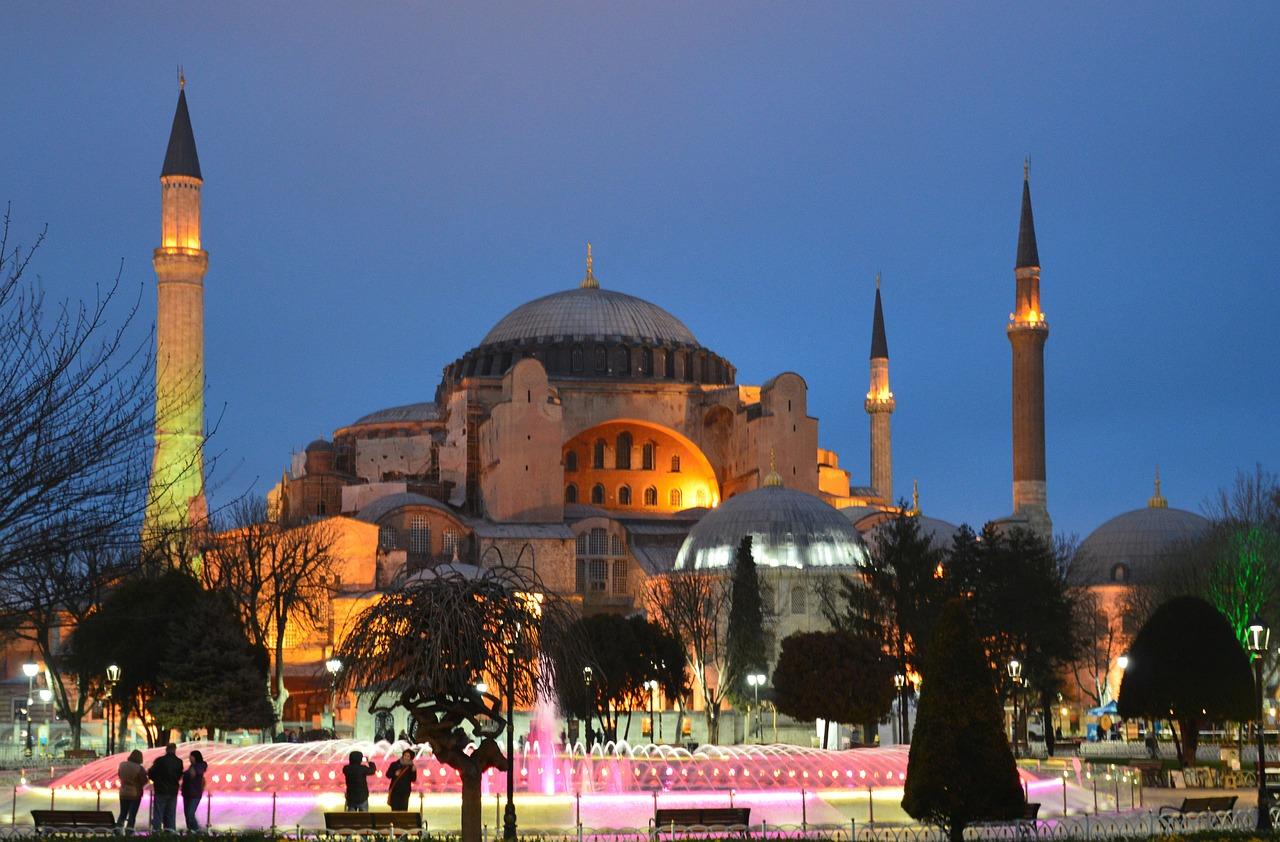
The former Byzantine cathedral and Ottoman mosque sits directly across from the palace's outer courtyard. Its massive dome and mosaics draw visitors before or after a Topkapi Palace visit.
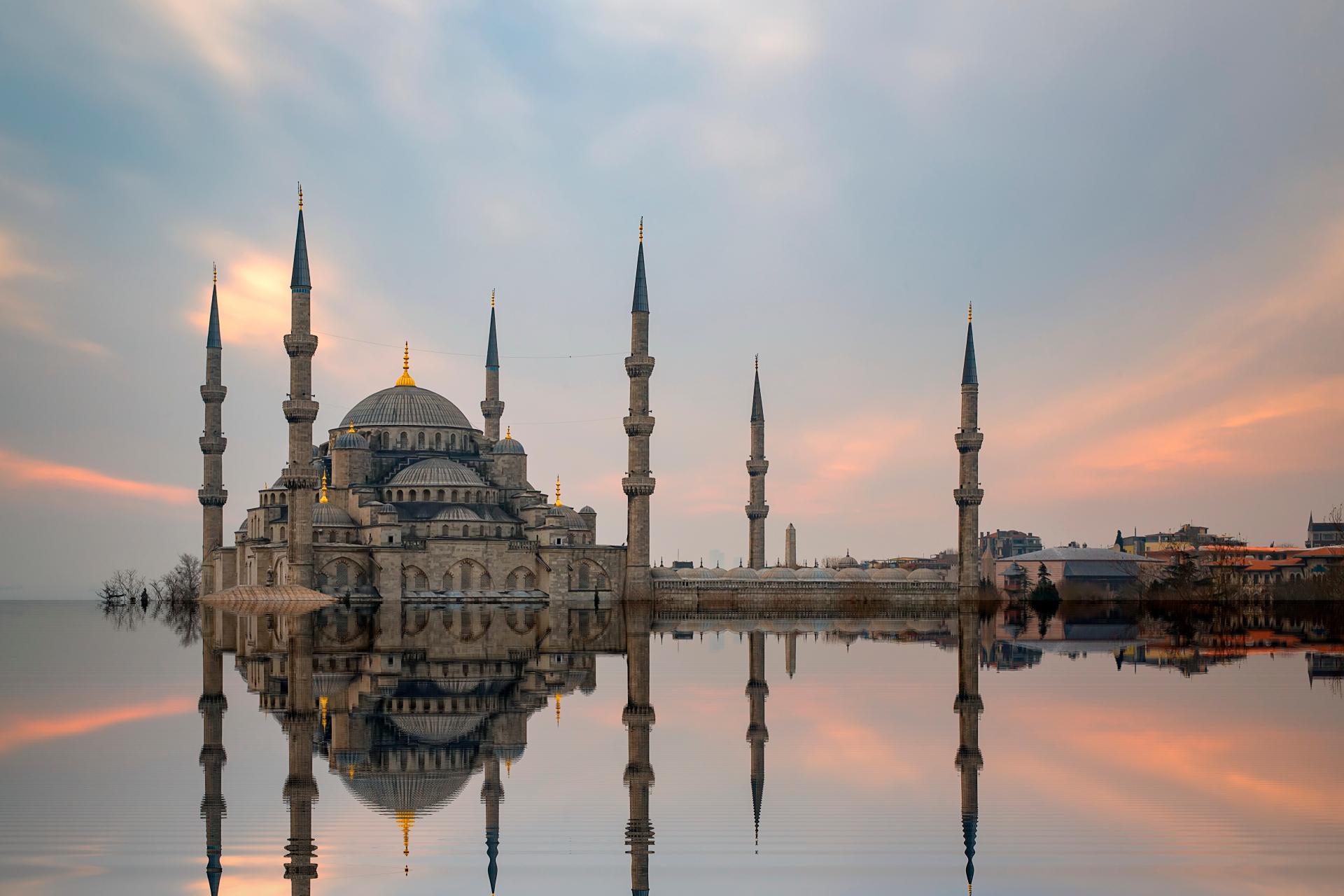
Known for its six minarets and blue Iznik tilework, the Sultan Ahmed Mosque is a short walk through Sultanahmet Square.
This underground Byzantine water reservoir features hundreds of columns and two carved Medusa head bases.
A former palace garden now open as a public park with tulip displays in spring and views toward the Golden Horn.
Housing the Alexander Sarcophagus and ancient artifacts, this museum complex sits just below the palace's outer walls.
A former Ottoman prison converted into a five-star hotel a short walk from the palace grounds.
A row of restored wooden Ottoman houses offering boutique rooms near Hagia Sophia.
A mid-range boutique hotel with rooftop terrace views over the Blue Mosque.
The historic peninsula around the palace holds dozens of budget guesthouses and hostels within walking distance.
Join thousands of happy travelers who have discovered this incredible experience
Book Your Experience Now