
3 hr
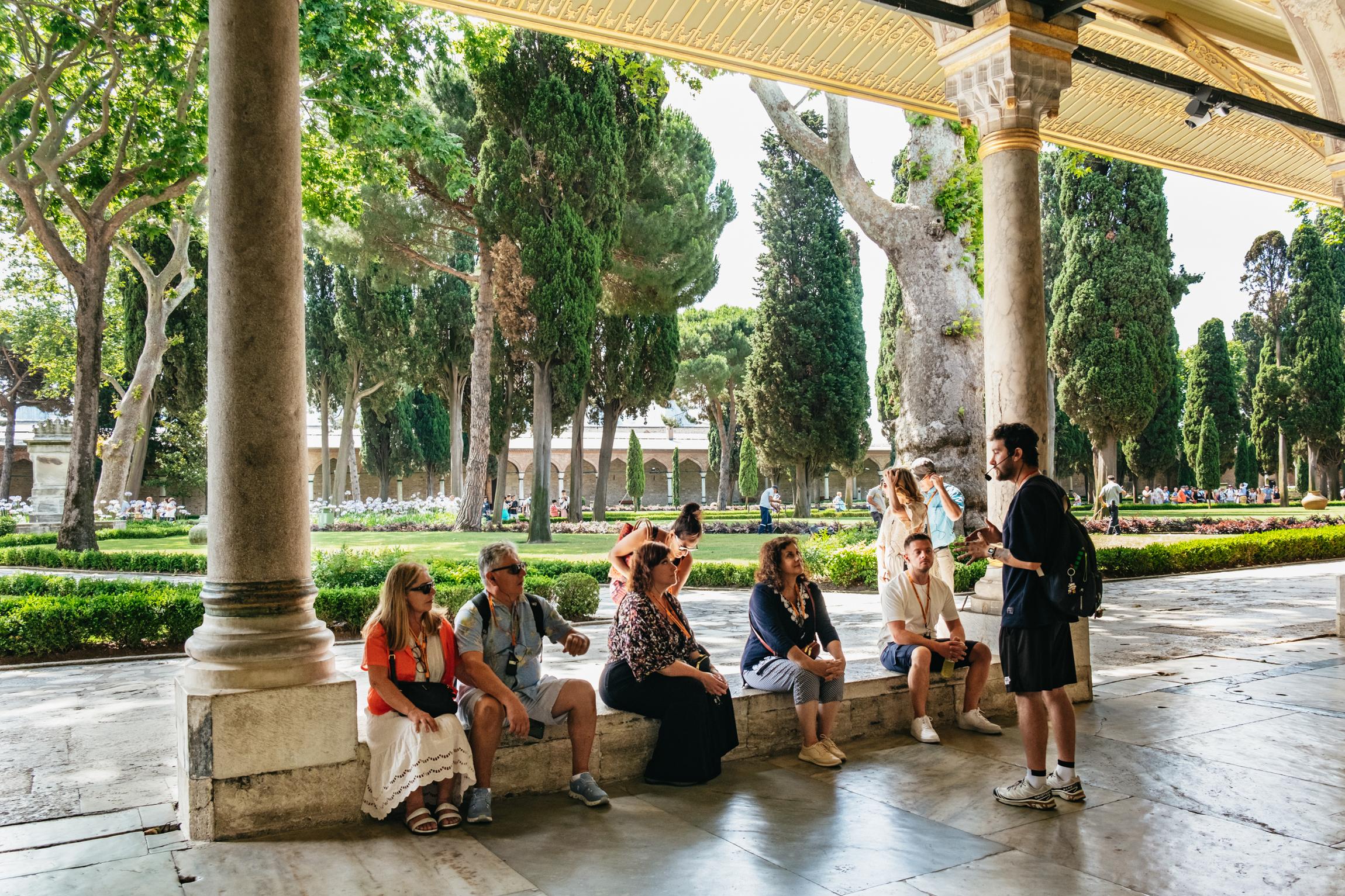
Topkapi Palace & Harem Guided Experience
- Expert local guide
- Small group
- Skip-the-line access
- Free cancellation
Topkapi Palace — Skip-the-Line Entry, Harem Access & Guided Tours
Four courtyards of Ottoman rule, one gate held open for you.
Compare fares, pick the fit — all bookings are mobile-voucher and eligible for free cancellation where shown.
3 hr
72 hr
Worth it for first-time visitors, skippable for repeat trips
At 2,750 TRY, the main gate ticket bundles the Harem in — and that bundle is what makes a topkapi palace skip the line ticket pay off. For one price you get the Imperial Treasury, the Sacred Relics chamber, the Harem's tiled apartments, and four courtyards that once ran an empire. Split across those four attractions, the per-site cost is modest for a UNESCO-listed Ottoman palace of this rank. The value tilts sharply by visitor type. First-timers and anyone drawn to the jewels, calligraphy, and Islamic relics extract the most from topkapi palace skip the line tours, since the queue at the Harem alone can swallow an hour in summer. Budget backpackers doing Istanbul landmarks on a tight wallet, or travelers indifferent to decorative arts, will find the combined gate steep. Weigh what draws you before booking a saray gezisi.
Bottom line: For a first Istanbul visit, a topkapi palace skip the line tour earns its 2,750 TRY; frugal repeat travelers can pass.
Both belong on a Sultanahmet itinerary, but a topkapi palace skip the line entry suits travelers chasing Ottoman courtyards and relics, while Dolmabahce rewards those who want a guided, chandelier-lit European-style interior.
|
Top pick Topkapi Palace |
Dolmabahce Palace | |
|---|---|---|
| What you see | Ottoman courtyards, Harem, imperial relics | Chandeliered halls, Crystal Staircase, Ataturk's rooms |
| Architectural style | Classic Ottoman palace complex | 19th-century European-Ottoman fusion |
| Guided vs self-paced | Self-paced, audio guide optional | Guided tour required, entry by group |
| Location in Istanbul | Sultanahmet, old city center | Besiktas, on the Bosphorus shore |
| Typical duration | 2–3 hours | 1.5–3 hours, tour-paced |
| Best for | History lovers, ruins and artifacts | Interior design and 19th-century opulence fans |
| See tickets & prices |
Verdict: Pair a skip-the-line Topkapi Palace tour with Dolmabahce if time allows, but travelers with only one slot should pick Topkapi for depth of history and Dolmabahce for palatial interiors.
Hand-picked experiences loved by thousands of travelers
20 minutes to 3 hours
Free Cancellation
Discover Istanbul’s imperial past with priority access to the Topkapi Palace, its courtyards, and legendary treasury.
4 hours
Free Cancellation
Discover Ottoman majesty on a private 4-hour tour of Topkapı Palace with expert commentary and priority entry.
3.5 hours
Free Cancellation
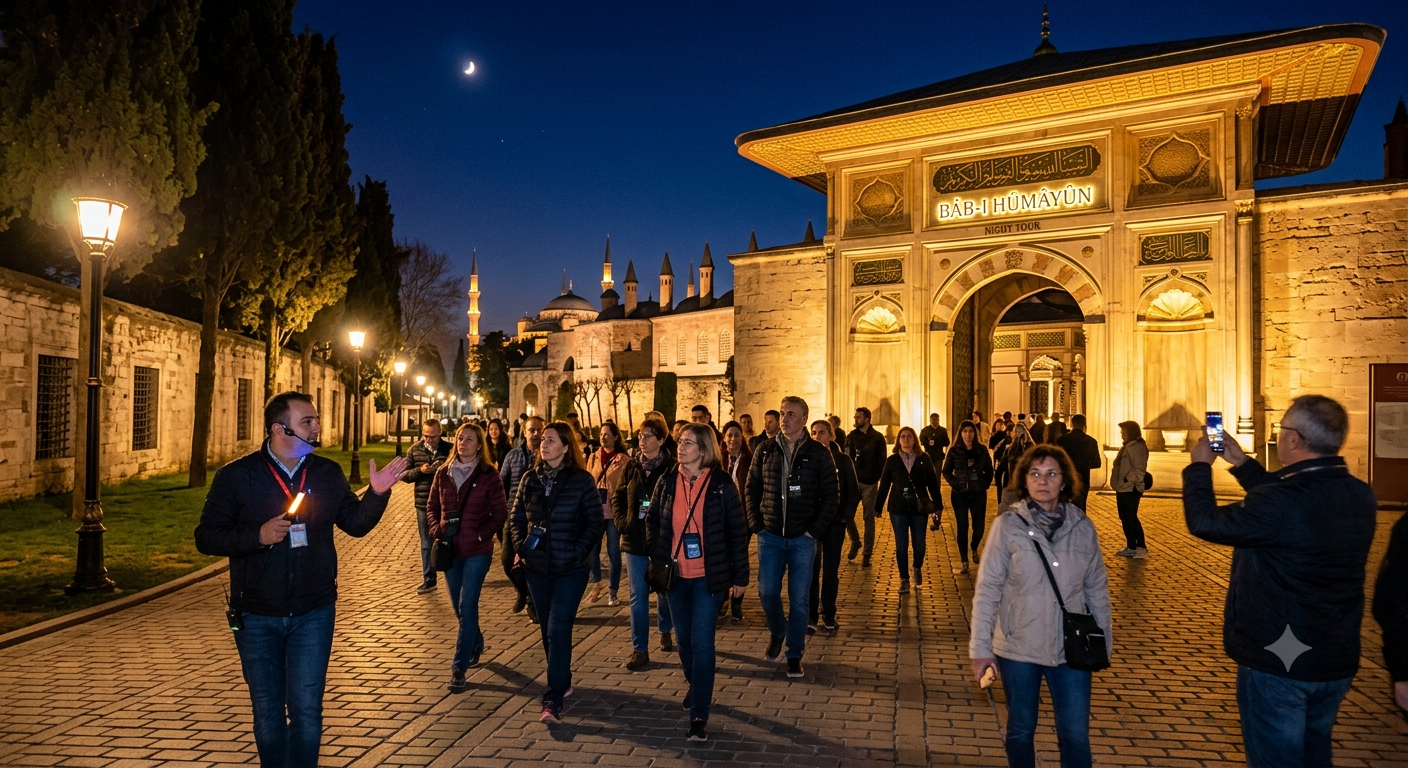
Experience the grandeur of the Ottoman Empire during an intimate after-hours exploration of Istanbul's historic palace.
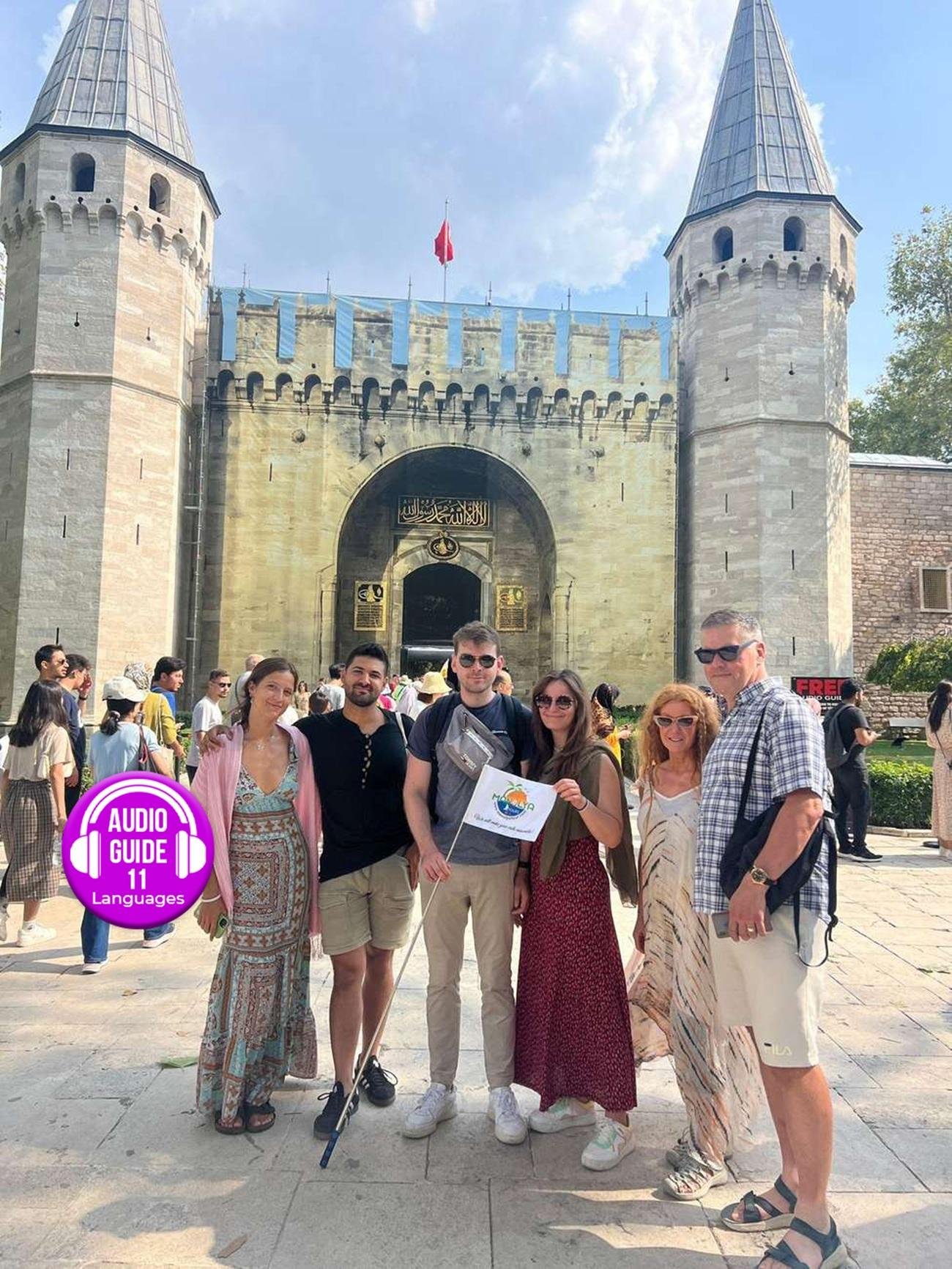
Pass security and enter the First Courtyard past Hagia Irene
Cross the Gate of Salutation, tour the Divan and Harem apartments
View the Topkapi Dagger and Spoonmaker's Diamond in the Imperial Treasury
See relics attributed to the Prophet Muhammad in the Privy Chamber
Stroll the Baghdad and Revan Kiosks with Bosphorus views
Browse the porcelain collection before leaving through the Second Courtyard
Housed in four rooms of the Third Courtyard, this collection includes the 86-carat Spoonmaker's Diamond and the emerald-studded Topkapi Dagger commissioned in 1747 as a gift for the Persian Shah. Queues here can stretch 15-30 minutes during peak season despite its relatively small footprint.
Located within the Privy Chamber of the Third Courtyard, this room preserves items attributed to the Prophet Muhammad and earlier prophets, viewed under deliberately dim lighting to protect the relics. A continuous Quran recitation has been maintained here for centuries as part of the site's religious tradition.
This complex of over 400 rooms once housed the sultan's family and was strictly off-limits to outsiders, entered today through a separate ticketed section beyond the Second Courtyard. The Imperial Hall, or Hünkâr Sofası, is the largest domed ceremonial space inside it.
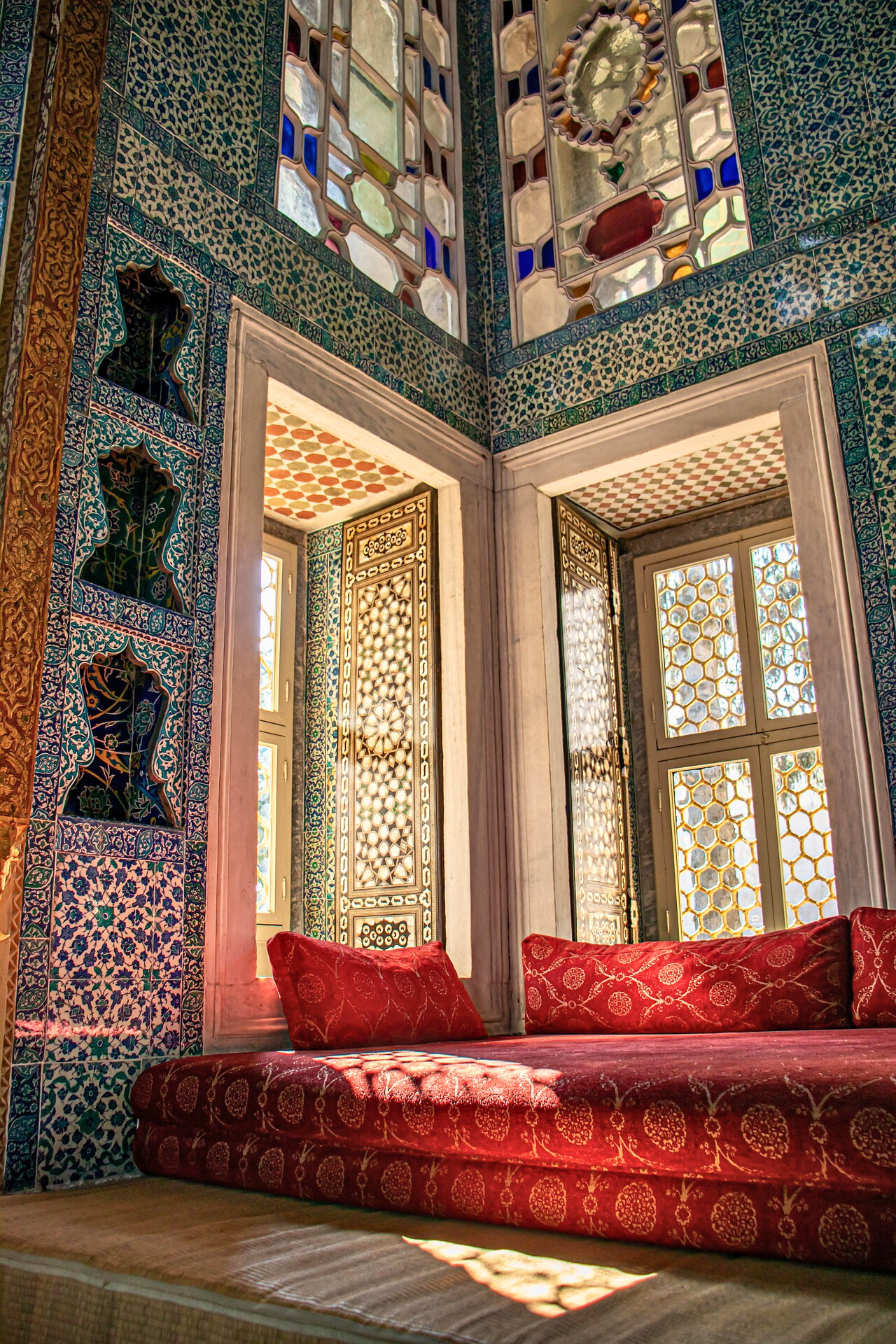
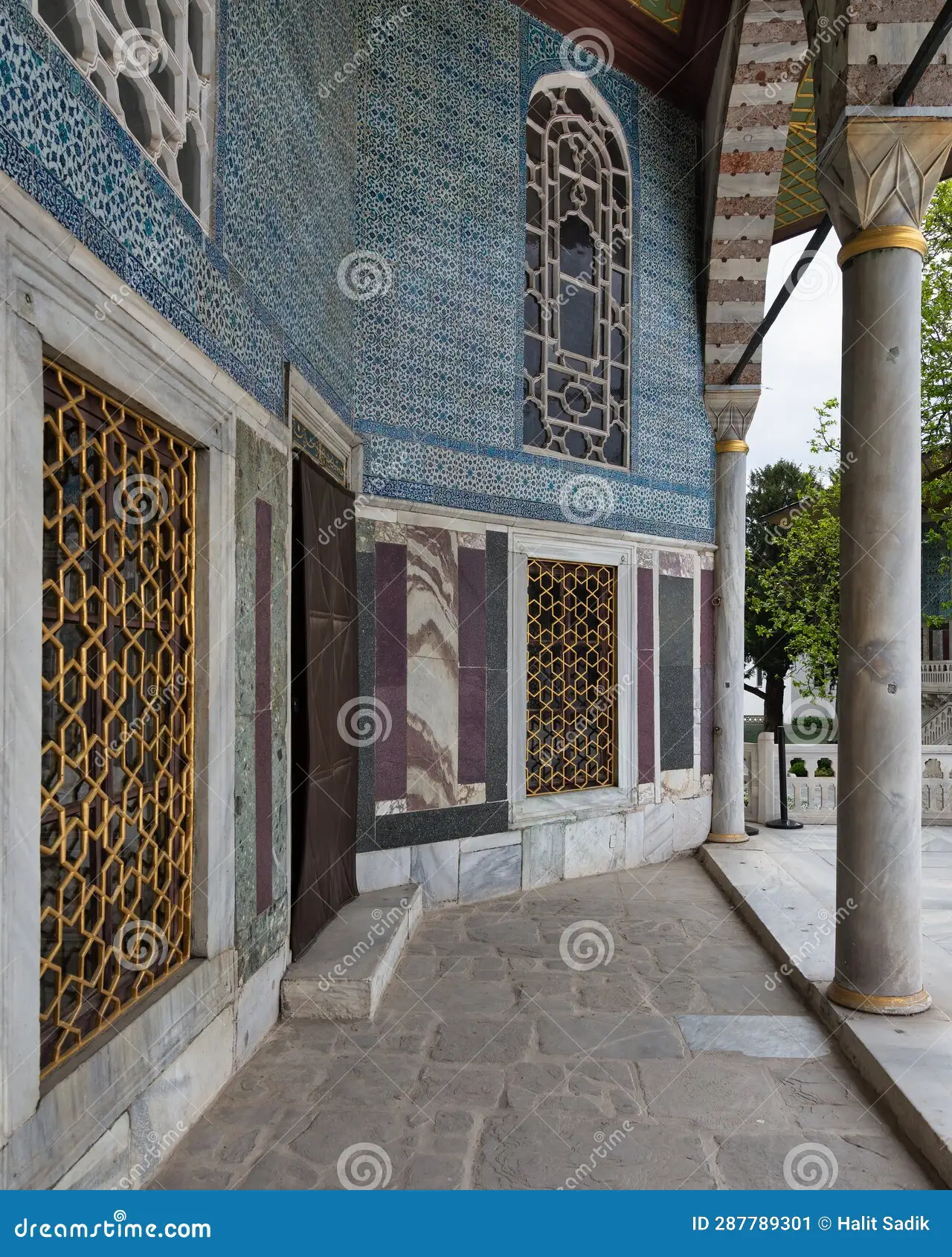
Built in the Fourth Courtyard to commemorate Sultan Murad IV's 1638 conquest of Baghdad, this pavilion is faced in vivid blue and green Iznik tiles. Its interior includes mother-of-pearl inlay and a silver fireplace grill given as a gift from France's King Louis XIV.
Stretching along the Second Courtyard, this row of kitchens once fed up to 4,000 people daily within the palace and now displays an extensive collection of Chinese and Ottoman porcelain. Ten domed chimneys still punctuate the Istanbul skyline above the complex.
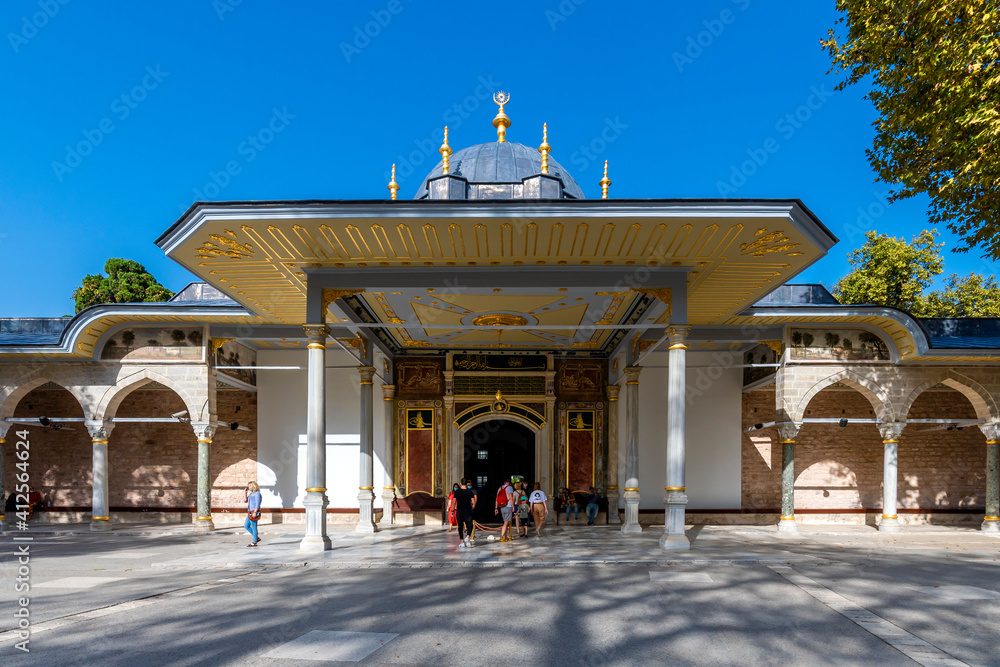
This ornate ceremonial threshold marks the entrance to the Third Courtyard and was historically where enthronement and funeral ceremonies for sultans took place. Its canopy roof and gilded calligraphy mark the formal transition into the palace's most private inner sanctum.
You reach the Imperial Gate on Babıhümayun Caddesi and, with a topkapi palace skip the line ticket, pass the queue straight into the first courtyard, where plane trees shade the path toward the Byzantine church of Hagia Irene. You cross to the Gate of Salutation, scan your mobile voucher, and step into the ceremonial second court. Ahead, the ten domed chimneys of the palace kitchens rise on your right; you turn left first for the Imperial Council chamber and the Divan Tower. You pace yourself through the Gate of Felicity into the third court, pausing at the Audience Chamber before the Treasury, where you slow down for the Spoonmaker's Diamond and the emerald-set dagger. You keep your separate Harem ticket ready, then thread the tiled corridors of its three hundred rooms, tracing İznik panels from the Queen Mother's apartments to the imperial hall. You finish on the fourth-court terrace, standing between the Baghdad Kiosk and the marble pool with the Bosphorus opening below. Arriving between 09:00 and 10:30, at opening, you move ahead of the midday tour buses and read each threshold without pressure. Skip-the-line topkapi palace tickets turn a four-courtyard maze into a single unbroken walk.
All the details about your upcoming adventure in one place
A topkapi palace skip the line entry lets you bypass the ticket queues at the Imperial Gate and step straight into the courtyards that once housed Ottoman sultans. Guides walking these topkapi palace skip the line tours point out the Imperial Treasury, the Harem quarters, and the Bosphorus panorama from the Fourth Courtyard. It's a straightforward way to see one of Istanbul's defining landmarks without losing the morning to slow entry lines.
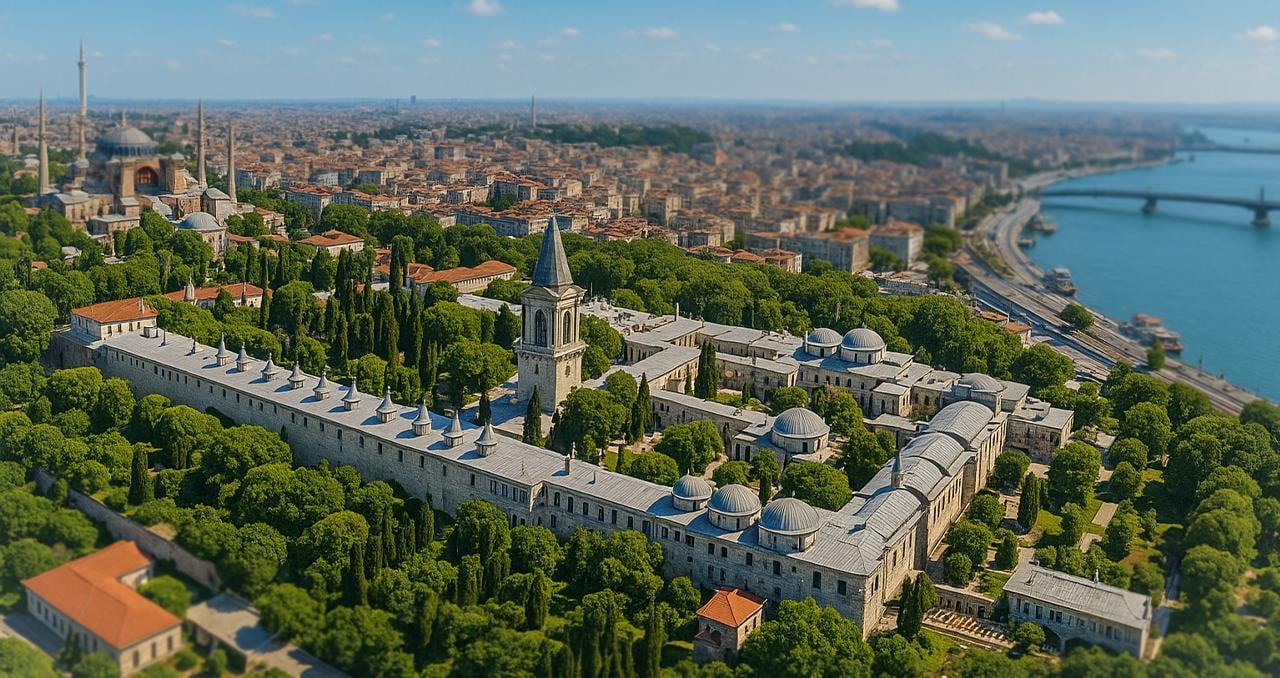
The Topkapi Palace served as the residence of Ottoman sultans for nearly four hundred years, from the 1460s until the court relocated to Dolmabahçe in 1856. A topkapi palace skip the line ticket carries visitors into a compound that was never a single building but a walled city of pavilions, kitchens, treasuries and gardens, laid out along a spine of four successive courtyards that grow more private as one moves inward. The palace occupies Seraglio Point, the promontory where the Golden Horn, the Bosphorus and the Sea of Marmara converge, and from its terraces the water is visible on three sides. Sultan Mehmed II chose the site shortly after the conquest of Constantinople in 1453 precisely for that commanding position over the strait. The Imperial Gate, or Bâb-ı Hümâyûn, opens onto the first courtyard, once accessible to ordinary subjects; beyond the Gate of Salutation lies the ceremonial second court, and past the Gate of Felicity the third and fourth courts held the sultan's private quarters and the enderun school. What gives the museum its topical depth is the density of what survives inside these walls. The Imperial Treasury holds the Topkapi Dagger and the 86-carat Spoonmaker's Diamond. The Chamber of the Sacred Relics keeps objects associated with the Prophet Muhammad, brought to Istanbul after Selim I's Egyptian campaign of 1517. The Harem, a warren of some three hundred rooms sheathed in İznik tile, housed the sultan's mother, consorts and the eunuch corps, and its blue-and-white panels remain among the finest ceramic surfaces in the Islamic world. The Ottoman heritage of the site is registered within Istanbul's Historic Areas on the UNESCO World Heritage list, and skip-the-line topkapi palace access is now how most foreign visitors reach it. Architecturally, the palace refuses the symmetry of European royal seats. It accreted over generations, each sultan adding a kiosk, a portico, a fountain, so that the Baghdad Kiosk of 1639 sits near colonnaded terraces raised a century earlier. The tiled Circumcision Room, the gilded Fruit Room and the Divan Tower punctuate the plan without unifying it. Among Istanbul landmarks it is the one that most rewards slow reading, its meaning held in the sequence of thresholds rather than any single façade. For that reason topkapi palace guided tours pair the topkapi palace skip the line tour with a route through the courtyards, so the layered chronology reads as a narrative rather than a scatter of rooms.
The palace was never a single building but a walled city of pavilions, growing more private with every courtyard.
There is no strict dress code to enter Topkapi Palace Museum itself, but modest clothing covering shoulders and knees is recommended since the grounds include Hagia Irene and areas adjoining active mosque courtyards nearby. Comfortable flat shoes are essential given the uneven cobblestones across the four courtyards.
All visitors pass through an airport-style metal detector and bag scan at the Imperial Gate before entering the First Courtyard. Large suitcases, backpacks over cabin size, and tripods are not permitted inside the Treasury or Harem sections and must be left at the entrance cloakroom.
Photography without flash is allowed in the courtyards, kitchens, and most pavilions, but is strictly prohibited inside the Chamber of Sacred Relics and the Treasury rooms where the Spoonmaker's Diamond is displayed. Video recording and tripods are banned throughout the Harem section.
Children aged 0-6 enter free, and strollers can navigate the main courtyards though not the Harem's narrow corridors. Shaded benches near the Palace Kitchens and Fourth Courtyard gardens work well for rest stops with young children.
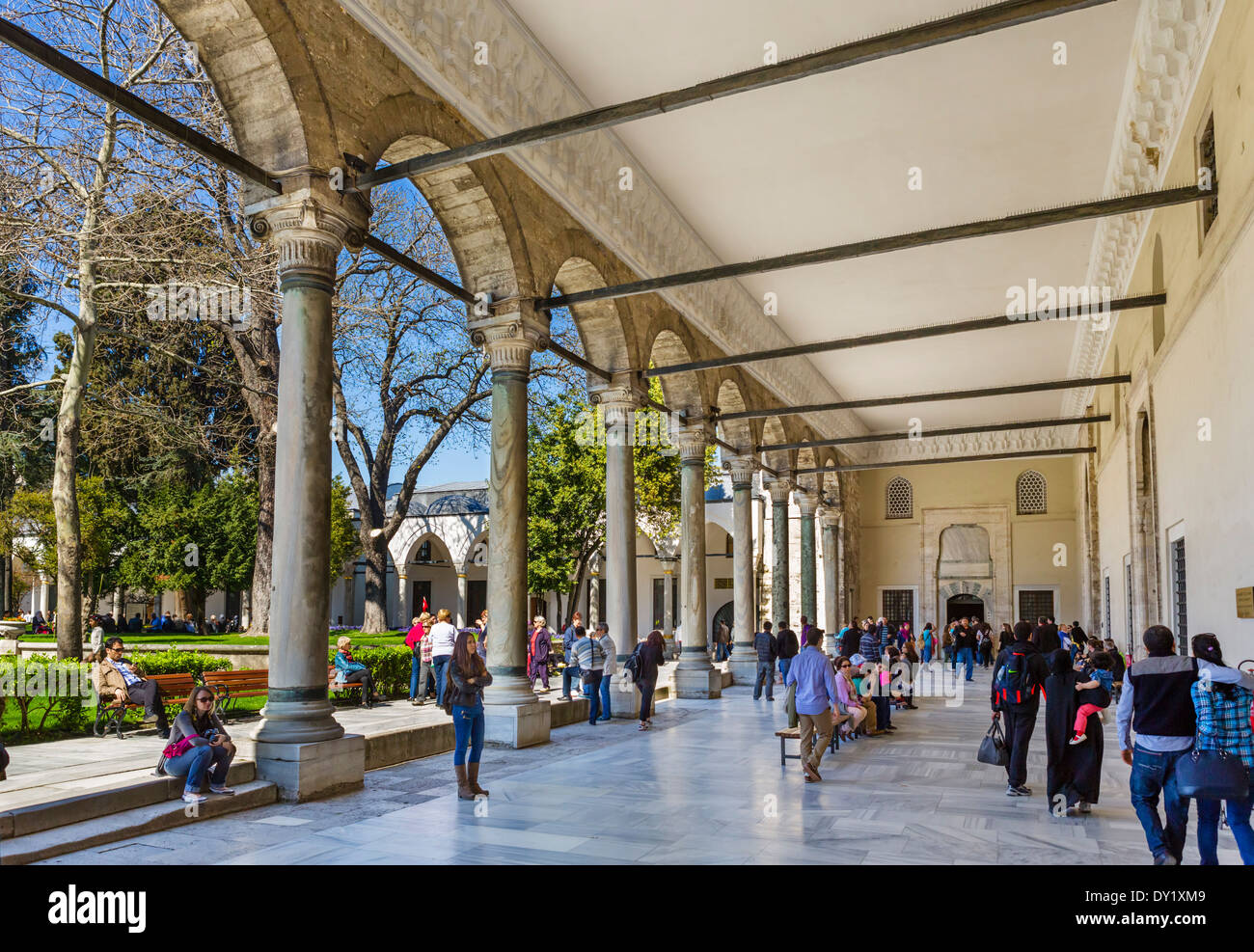
The First and Second Courtyards have paved, wheelchair-navigable paths, but the Fourth Courtyard's kiosks and the Harem involve stairs and raised thresholds with limited step-free routes. Visitors with mobility needs should ask staff at the Imperial Gate about the accessible route through the Harem before purchasing that add-on ticket.
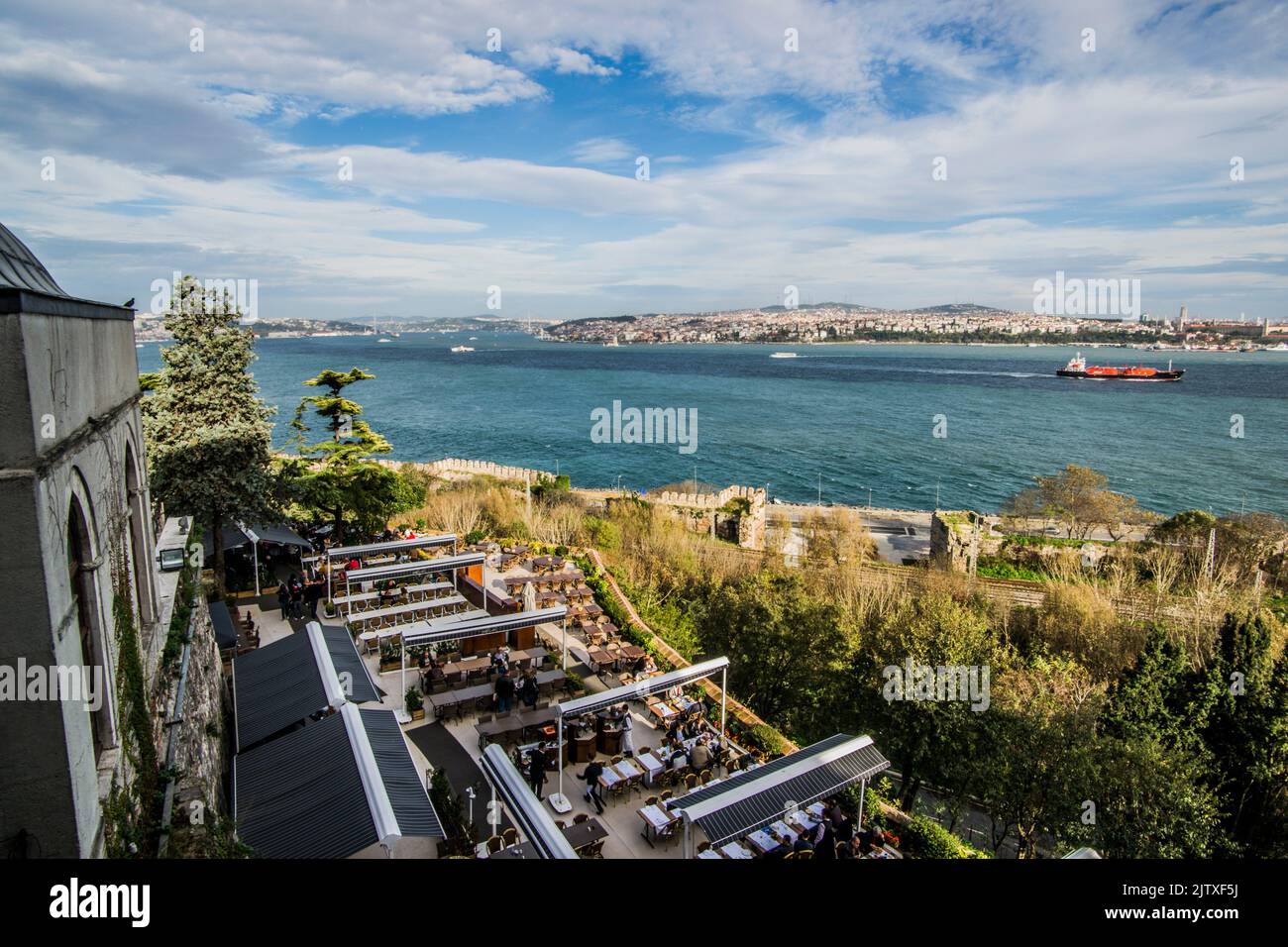
A palace restaurant (Konyalı) overlooking the Bosphorus operates in the Fourth Courtyard, along with a smaller cafe near the First Courtyard for tea and snacks. Outside food and drink other than water are not permitted inside the exhibition halls, Treasury, or Harem.
Ticket office opens 09:00
Weekly closure, no exceptions
Popular with school groups
Busiest day of the week
Hours
Open daily 09:00–18:00 except Tuesdays
Address
Cankurtaran Mah. Babihumayun Cad. No:1, 34122 Sultanahmet, Fatih, Istanbul, Turkey
Access
Cobblestone courtyards, ramps at main entrance, Harem has steps
Best arrival
09:00–10:30 to avoid peak midday tour bus crowds
Bag policy
Large backpacks and suitcases must be checked at the cloakroom
Public transport · 20-35 min from Taksim · Istanbulkart fare, a few Turkish Lira
Take the T1 tram to the Sultanahmet or Gülhane stop, both roughly 5-10 minutes' walk from the Imperial Gate. The T1 connects to Kabataş for the funicular from Taksim and to Sirkeci for the Marmaray cross-Bosphorus train.
Walk · 5-10 min · Free
From Hagia Sophia or the Blue Mosque, it is a flat 5-10 minute walk through Sultanahmet Square to the Imperial Gate entrance.
Taxi · 10-20 min from most European-side hotels · Metered fare, moderate cost
Taxis can drop passengers on Soğukçeşme Sokak near the Imperial Gate, though traffic in Sultanahmet is often heavy during the day.
Car · Variable · Parking fees plus congestion delays
Driving is discouraged since public parking near the palace is extremely limited and the Sultanahmet district has restricted traffic zones.
Tickets bought at the gate for Topkapi Palace Museum are non-refundable once issued. Pre-booked skip-the-line tickets can typically be cancelled up to 24 hours before the visit date for a full refund of the 2,750 TRY entrance fee; check the specific reseller's terms since the museum's own ticket office does not process refunds.
Recommended time
3-4 hours
Budget three to four hours for courtyards, Treasury, and Sacred Relics room plus the Harem, since the palace grounds are large and the one-way Harem route through the Third Courtyard alone takes 45-90 minutes. Arriving at 09:00, right at opening, is the real advantage of topkapi palace skip the line entry, since it lets you clear security and reach the Harem while the corridors are still uncrowded. Add 30 minutes if tour buses are visible in the parking area, since queues at the ticket booths and Harem entrance stretch fast once groups converge around midday. Subtract an hour if you plan to skip the Harem and focus on the outer courtyards and kitchens only.
Crowd levels through the day
Weather · crowds · average price — dots go green to amber to red as each metric rises.
Mild 15-20°C weather and moderate crowds make April and May comfortable months for a topkapi palace skip the line visit before the summer surge. Tulip season in nearby Gülhane Park adds extra color to the walk in.
July and August bring heat above 28°C and the heaviest tour bus traffic of the year, making a topkapi palace skip the line ticket most valuable in this window. Early morning visits are essential to avoid midday queues at the Harem.
September and October offer cooler temperatures and thinner crowds than summer, making this arguably the best all-round season to explore the four courtyards. Rain becomes more frequent by late October.
Cold, occasionally rainy days from December through February bring the lowest visitor numbers of the year. Some open-air kiosks in the Fourth Courtyard feel less inviting in winter chill, but the Treasury and Harem stay comfortable indoors.
Reserve a topkapi palace skip the line ticket online before arrival since the ticket-window queue can exceed 45 minutes in summer. Online tickets also let you pick a specific entry slot.
The Harem requires its own add-on ticket beyond the 2,750 TRY main entrance fee and is not covered by the Museum Card. Purchase it at the same time as the main ticket to avoid a second queue.
The side entrance near Gülhane Park often has shorter lines than the main Imperial Gate, especially for those arriving by tram.
Head to the Imperial Treasury and Sacred Relics Chamber before mid-morning tour groups arrive, since both rooms bottleneck quickly.
Card payment isn't always reliable at the smaller kiosks inside the grounds, so keep some Turkish Lira on hand for snacks.
The Museum Pass Istanbul covers the main palace but not the Harem or Hagia Irene, so budget separately for those sections.
The courtyards offer little shade at midday in July and August, so a hat and water bottle make a real difference during a topkapi palace skip the line tour.
Cankurtaran Mah. Babihumayun Cad. No:1, Sultanahmet, Fatih, Istanbul
Main entrance, opposite Hagia Sophia
Get directionsAdjacent to Istanbul Archaeological Museums, Gülhane, Fatih
Alternate entry with shorter queues
Get directionsIn 1459, six years after conquering Constantinople, Sultan Mehmed II ordered construction of a new residence on the promontory where the Byzantine acropolis once stood. Builders raised the first courtyards and pavilions by 1465. The complex was called the New Palace, distinguishing it from the sultan's earlier seat in Beyazit. Only in the nineteenth century did it acquire the name Topkapi, meaning Cannon Gate, after a lost shore pavilion. The history behind your topkapi palace skip the line visit begins with this deliberate act of imperial relocation. For nearly four centuries the palace served as the administrative core of the Ottoman state. The Imperial Council met in the Divan; janissaries mustered in the first court; the Enderun school trained the empire's administrators. Suleiman the Magnificent expanded the grounds through the sixteenth century, and successive sultans added the Baghdad Kiosk in 1639, celebrating Murad IV's eastern campaign. Water, marble, and Iznik tilework defined a layered ceremonial geography that few outsiders ever entered. Those touring today with topkapi palace skip the line tickets pass through gates that once separated the sacred from the profane. Two functions anchored the palace's later identity. The Harem, a walled quarter of some four hundred rooms, housed the sultan's family, the Valide Sultan, and the eunuch corps who guarded them. After Selim I's 1517 conquest of Egypt, the Sacred Relics of the Prophet Muhammad were brought to Istanbul and installed in the Privy Chamber, making the palace a custodian of Islamic heritage. Recognition of Istanbul landmarks like this drives the demand behind topkapi palace skip the line tours. Decline followed the court's departure. In 1856, Sultan Abdulmecid I moved the imperial household to the new Dolmabahce Palace on the Bosphorus, leaving Topkapi to caretakers and the treasury. The old rooms held state archives and jewels but no longer governed. After the empire fell, Mustafa Kemal Ataturk's young republic ordered the palace opened to the public, and it became a museum on 3 April 1924. A UNESCO World Heritage listing followed in 1985. What survives is a working record of Ottoman rule, which visitors on any topkapi palace skip the line tour can still read across its four courtyards. The Istanbul heritage sites of Sultanahmet owe much of their gravity to this preserved seat of power.
Mehmed II orders construction of the New Palace on the former Byzantine acropolis.
Selim I brings the Sacred Relics to Istanbul after conquering Egypt.
Suleiman the Magnificent expands the grounds and Harem quarters.
The Baghdad Kiosk is completed for Murad IV's eastern victory.
Abdulmecid I moves the court to Dolmabahce Palace on the Bosphorus.
The palace opens to the public as a museum on 3 April.
UNESCO inscribes the palace on the World Heritage List.
Stand across the street facing Hagia Sophia to frame the fortress-like gate with its Ottoman calligraphy overhead; this is also where lines form for those booking a topkapi palace skip the line entry, so shoot before queues build.
The twin conical towers of this fortified inner gate create a symmetrical shot when photographed head-on from the middle of the First Courtyard path leading toward it. Only foot traffic passes through, so a centered composition is easy to line up without cropping out tourists on either side.
The open terrace beyond the Third Courtyard gives a wide panorama over the Bosphorus, Sea of Marmara, and Asian shore, best captured by standing at the stone balustrade near the Baghdad Kiosk. Space is generous compared to the inner courtyards, so wide-angle shots of the water rarely get blocked.
This gilded, tulip-roofed pergola jutting from the courtyard edge is the palace's most photographed viewpoint, framing the Golden Horn between its gold columns. Position yourself slightly off to one side so the columns bracket the water instead of blocking it.
Near the Konyalı Restaurant terrace at the courtyard's southeastern corner, this spot looks south over the Sea of Marmara and draws fewer visitors than the Iftariye viewpoint. It works well for a quieter alternative angle on the same coastline.
A topkapi palace skip the line entry gets families through the gate fast, but the visit itself is a long, open-air trek across four courtyards that rewards early arrival and realistic pacing rather than a packed checklist.
Strollers roll fine through the First and Second Courtyards' wide paths, but cobblestones and stair thresholds near the Harem and Treasury make a rugged, puncture-proof-wheel model far easier than an umbrella stroller; plan to park it and carry younger kids through exhibition halls.
Children around 6 to 12 engage best with the Weapons Collection and Palace Kitchens, while toddlers tend to enjoy the open courtyards more than the dense, low-lit rooms; a skip-the-line Topkapi Palace tour with a guide who tells sultan stories helps hold younger attention.
Toilets and baby-changing rooms are on-site and marked on the palace map, with cafeterias in the courtyards for a quick reset between sections.
Treat the First Courtyard as a running-around warm-up, then slow down for the Second and Third; kids typically disengage inside the Harem's maze of small rooms faster than in the open squares, so save it for when energy is still high.
Bring water, snacks, and sun protection, since queues and heat build quickly even with pre-booked entry.
Real experiences from real travelers
The topkapi palace skip the line ticket saved us at least an hour under a hot June sun while the standard line wrapped past the ticket booths. We were inside the First Courtyard by 9:15 and had the Imperial Council chamber almost to ourselves before the crowds thickened.
Booked the topkapi palace skip the line tours after a friend warned us about the midday crush, and it was the right call. Our guide explained the Iznik tiles in the harem quarters clearly, and the Bosphorus terrace was breezy and calm when we reached it.
The entry itself was smooth thanks to skip-the-line access, though nothing stops the bottleneck at the Treasury once you are in. Still, standing under the gilded canopy of the Gate of Felicity in soft light made the early start worthwhile.
We visited on a crisp March morning and the istanbul topkapi palace tour let us walk the Third Courtyard while frost still lingered on the lawns. Having the topkapi palace skip the line tickets meant we spent our energy on the exhibits instead of the queue.
Autumn light over the Golden Horn from the palace terrace was gentle and golden, and the crowds were thinner than I expected. The skip-the-line topkapi palace entry got us in fast, and the sacred relics room was quiet enough to actually read the plaques.
In peak July heat the standard queue looked brutal, so the topkapi palace skip the line tour felt like a small miracle. We were shaded in the Baghdad Kiosk courtyard admiring the blue tilework while others baked outside the gates.
A grey February afternoon meant fewer tourists overall, but the fast-track entry still shaved time at the main gate. The view of Hagia Irene from the First Courtyard stood out even under flat winter cloud.
The istanbul landmarks around Sultanahmet blur together, but Topkapi stayed with me for its tiled corridors and sea views. Our topkapi palace skip the line tours guide moved us efficiently through the harem before the tour groups arrived.
We collected our passes and were through the entrance in minutes while a long line snaked behind us in the cold. The panorama of ferries crossing the Bosphorus from the palace edge was the highlight of our Istanbul trip.
Skipping the queue was genuinely useful on a busy day, though the added cost stung a little. The mother-of-pearl inlay in the imperial rooms and the courtyard plane trees were the parts I remember most.
Everything you need to know for your journey
Topkapi Palace Museum is open daily from 09:00 to 18:00, except Tuesdays when it is closed. Last entry is typically about an hour before closing, so plan a topkapi palace skip the line visit to start well before late afternoon.
Yes, Topkapi Palace Museum is closed every Tuesday along with the first day of major religious holidays. Plan your topkapi palace skip the line tours around a Wednesday-through-Monday schedule.
The main gate ticket, which includes the Harem, costs 2,750 TRY per foreign adult. Booking topkapi palace skip the line tickets online in advance secures this price without a wait at the ticket window.
Arriving between 09:00 and 10:30, right at opening, is the best way to beat the midday tour bus crowds that build up through late morning. A topkapi palace skip the line ticket purchased in advance lets you head straight to the Harem during this quieter window.
Large backpacks and suitcases must be checked at the entrance cloakroom before passing through security. Small daypacks are generally fine to carry throughout the palace and Harem.
Non-flash photography is permitted throughout most courtyards and pavilions but is prohibited inside the Treasury and the Chamber of Sacred Relics. Tripods and selfie sticks are also banned in the Harem's narrow corridors.
There's no strict enforced dress code for the palace itself, though modest clothing is recommended given the site's proximity to active mosque areas. Comfortable, flat shoes matter more, since the courtyards are paved in uneven cobblestone.
Yes, the Konyalı restaurant in the Fourth Courtyard offers Bosphorus views along with a smaller cafe near the entrance for lighter snacks and tea. Outside food isn't permitted inside the exhibition halls or Treasury.
The T1 tram is the easiest route, stopping at either Sultanahmet or Gülhane, both a short walk from the Imperial Gate entrance. From Taksim Square, take the F1 funicular to Kabataş and transfer to the T1 tram.
Children aged 0-6 enter free, and the main courtyards accommodate strollers, though the Harem's tighter corridors and steps are less stroller-friendly. Shaded rest areas near the Palace Kitchens and Fourth Courtyard gardens work well for family breaks.
Museum ticket window purchases are non-refundable, but many pre-booked topkapi palace skip the line tickets can be cancelled up to 24 hours ahead for a full refund. Check the specific booking provider's cancellation window before purchasing.
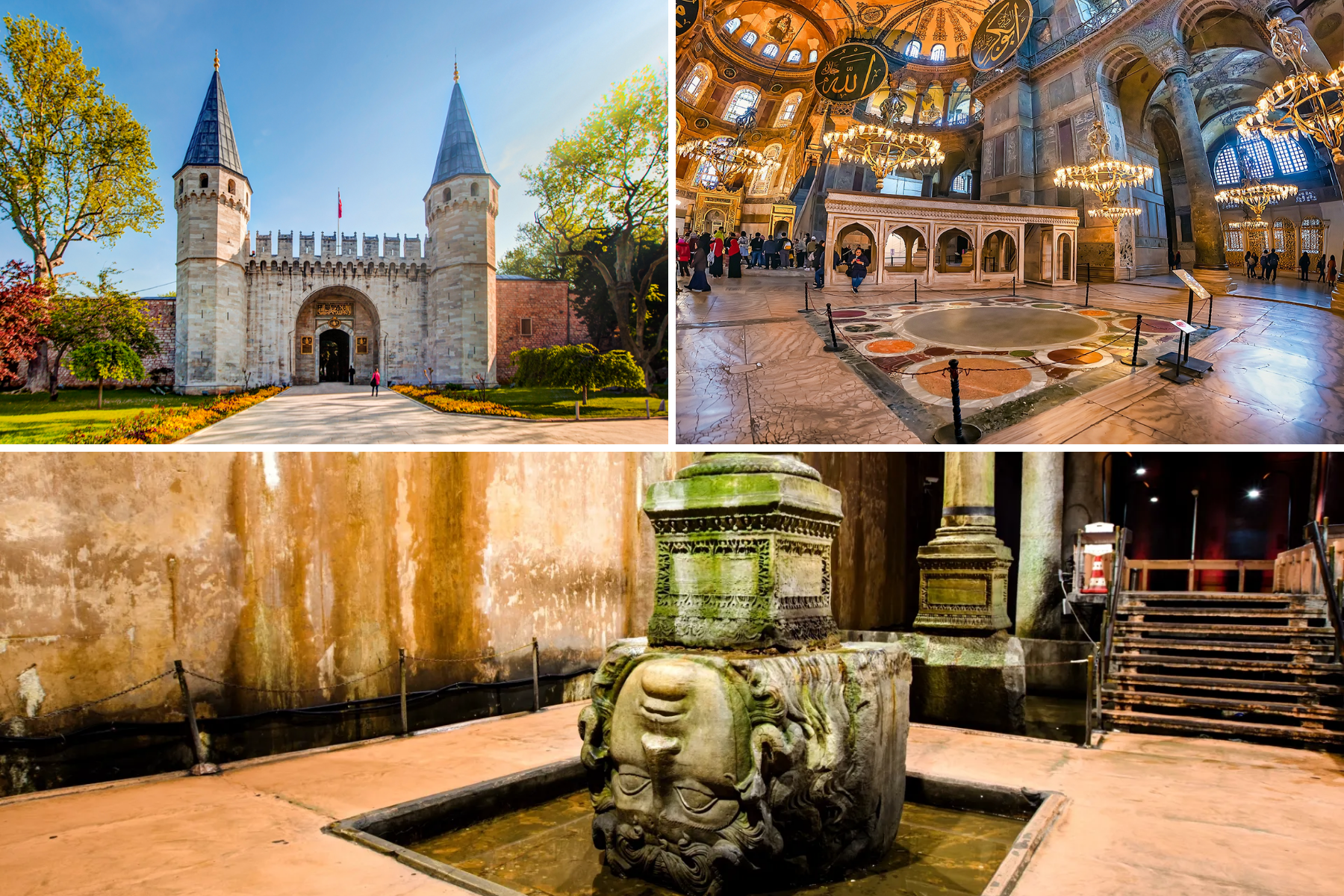
Hagia Sophia sits directly across the square, and the Blue Mosque and Basilica Cistern are both within a 10-minute walk, making them easy pairings with a topkapi palace skip the line tour.
The former Byzantine cathedral and Ottoman mosque sits directly across from the Imperial Gate. Its enormous dome and Byzantine mosaics make it a natural pairing with a palace visit.
Known for its six minarets and blue Iznik tile interior, the Sultan Ahmed Mosque is an active place of worship near Sultanahmet Square.
This 6th-century underground water reservoir holds 336 marble columns including two Medusa head bases.
Once the palace's outer gardens, this park now offers tulip beds in spring and a walking path down toward the Bosphorus shore.
Home to the Alexander Sarcophagus and an extensive collection of ancient artifacts from across the former Ottoman territories.
A former Ottoman prison converted into a five-star hotel with courtyard gardens steps from the palace walls.
A row of restored Ottoman wooden houses forming a small boutique hotel tucked behind Hagia Sophia.
The historic quarter surrounding the palace holds dozens of mid-range and budget guesthouses within a 10-minute walk of the Imperial Gate.
Join thousands of happy travelers who have discovered this incredible experience
Book Your Experience Now